An Interview with DFW support committee
〰️
An Interview with DFW support committee 〰️
In this episode, we sit down with members of the DFW Defense Committee to break down the state and federal repression facing local organizers and community members. We begin with who the defendants are and their relationship to the defense work, then move into what’s happening on the ground beyond the state’s narrative.
Listen Up
Defending Dissent In Texas: An Interview with DFW Prairieland Defense Committee
Jordan: [00:00:00] Right now in Sudan, anarchist comrades are organizing in the middle of a war, repression and displacement. The anarchist group in Sudan is building mutual aid, grassroots committees, and political education for survival and liberation, and they need our support. You can stand with them by making a one-time donation.
Holding your own fundraiser and sending the funds to the Open Collective support Sudanese Comrades Lincoln Bio, or become a monthly supporter at that same open collective link. Every contribution strengthens their ability to keep resisting and caring for their people. Solidarity means action. Tap the link in our bio or in their show notes and support the anarchist group of Sudan today.
Prince: Hey listeners, the dugout is all about sharing black radical history and ideas to spark learning and action. If you've gained [00:01:00] anything from these conversations, especially if you think we're cute, consider supporting us on Patriarch. Your support helps us cover production costs, bringing on our amazing guests.
Getting Jordan all cozy before they smoke their little doobie before each episode and beyond. Plus, you'll get early access to interviews and exclusive reading episodes. Head to patreon.com/the dugout pod to join us and keep this work going.
Hello everyone. Welcome to another episode of the Dugout, and we're doing an interview today. Our first question is to have you introduce yourselves and kind of talk about your role in the relationship to, uh, defense work that you're doing right now.
Hannah: I'm Hannah. I'm part of the DFW Support Committee. The defendants that I'm offering primary support for are [00:02:00] Rowan otherwise known as Joy Gibson, um, champagne, otherwise known as Ben Song, and Mari um, Mariella, ADA.
I just love these people and, um, I just really, really want them to come home.
Xavier: Hi there. My name is Javier Deon. I use he him pronouns. During the day, I work at the National Lawyers Guild as the Director of Mass Defense. Outside of that, I also represent political defendants across the South, and since this case happened, the incident on July 4th, the National Lawyers Guild has stepped up to provide support to the supporters and hopefully to the cases as much as we can.
Prince: Just setting the stage for people who are hearing about this case for the first time, how would you describe what's happening to the defendants beyond, um, the state's narrative?
Hannah: It's important to humanize clinical prisoners, so the state has its own [00:03:00] narrative that these people are terrorists, that they are pariahs in the community, but these people took care of people.
Whenever you needed anything, these are the people that you would call whenever people were hungry, whenever people were in a state of desperation, like these are the people that you would call. And these comrades are not just symbols of struggle, but real people. Some like Liz and Hammadi have children under the age of 18.
Their children are suffering this whole cruel ordeal. Reproduces for them the very conditions that they were fighting against. Fascist policies of family separation. Families are being separated. People that love each other are not allowed to talk. It's just cruelty upon cruelty upon cruelty, and they just wanna break the, break our people down.
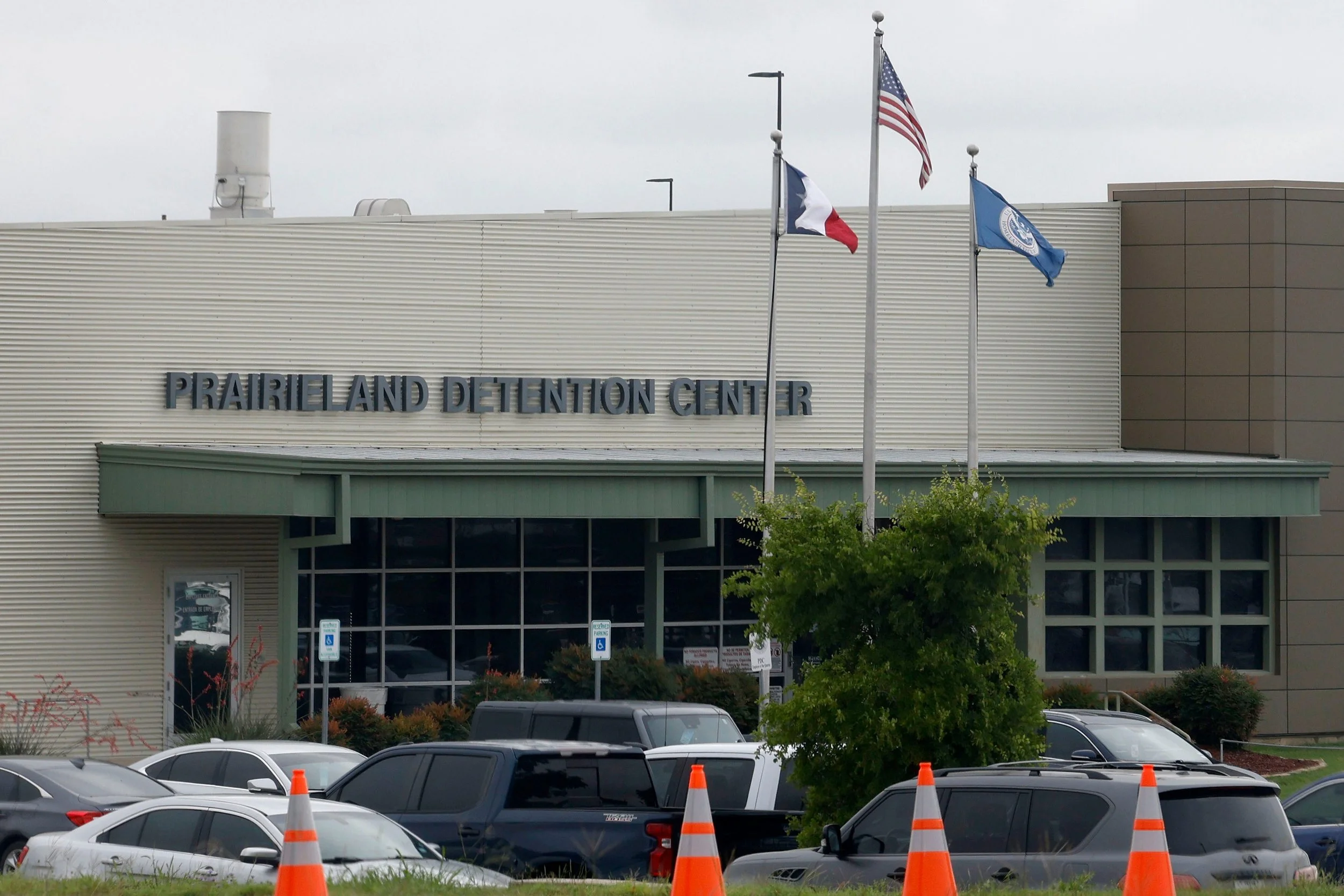
Xavier: Not only are the cases extreme, they are clearly political. This was just a noise demonstration in Northern Texas at an ice detention center. Then [00:04:00] based on allegations of the government that a cop was shot, now there's 18 people facing charges at the state and federal level with all these very fantastical theories that people were Antifa and in a terror cell and planning all of this along.
And yeah, I think it, it is pretty dreadful and, and telling how the government is. Behaving against these people. You know, the, the reality is that this was a noise demonstration and then what happened afterwards has been a result of the federal repression of individuals. And as was mentioned, I mean, the impact on people's lives to be framed as a terrorist is, yeah, it's, it's lifelong.
Only one person of the 18 was able to get a bond to, to be on pretrial release.
Jordan: Kind of in that spirit of going against a lot of the misinformation that's been out here, which even just [00:05:00] me reading the news and from other folks reading the news in my community is like a day to day struggle of like what actually happened and how people are talking about it.
People say something and I'm like, that sounds, I think you're referencing this, but that sounds like nothing like what happened. I know that in this area of Texas, it is a very repressive place in general. The county itself named after a Confederate and someone who fought for multiple ethnic lens reasons, as you were saying, like these are folks who were fighting against those and had ideals of their own.
And I'm curious if you could describe some of that local organizing context in Texas. And how maybe eventually it got to that relation with ice, but some of the Prairieland defendants
Hannah: are, are you asking like what organizing the Prairieland defendants did before everything, before they were arrested?
Jordan: Uh, yeah, like you were saying they were the people that you would go to for food or for anything like that. Or [00:06:00] if that was something. Or if it was just in this relation to the ice and repression or any context of organizing in that area in Texas,
Hannah: so many of them did like food Astros and mutual aid. One of the things that we were working on, Ari and Inez.
And were really big involved in like, uh, mutual aid, self and social therapy where we were trying to build an abolitionist alternative to people having to call the police on somebody having a mental health crisis. So that was one of the things that we were working on. Liz Vanna Manez and Ma. They were very big in the Edma Goldman book club and in political education trying to to make anarchist education accessible to as many people as possible.
Rowan and Champagne were big in the Palestine movement, as well as just. You know, food not bombs and taking care of people who have been neglected by the state and who have been thrown [00:07:00] away. They did some beautiful work over the years. Uh, they did a lot of just, you know, everyday mutual aid, especially Champagne.
And Rowan Lynette did a lot of. Everyday mutual aid, getting people what they need, helping people move, being there for people who need it. They're just all really, just really, really wonderful, wonderful humans. All of them. DFW organizing has. Deeply been infected about them. There's, I mean, there's a lot of fear, obviously, but also a lot of structures have collapsed.
Like we no longer have a fem council where we were in the process of addressing a lot of the misogynistic issues across. DFW organizing. We no longer have that. We no longer have a lot of the structures and like the queer self-defense. We don't have that anymore. Like, there's so many things that, that just don't exist anymore because the people that were, you know, providing the structures for those systems and [00:08:00] those systems of care are just not out here with us anymore.
And it's just. It's just fucking awful. And we're trying to rebuild, but it's hard when you're also trying to fight against the repression of the state. And, but yeah, it's, they are deeply missed right now.
Xavier: Even in hearing about some of the Prairie Land defendants is just how, this isn't even all of them, how broad these networks are.
Right? Like the, they, the organizing that's happening. Presently across the country in mutual aid, in immigrant rights, in abolishing prisons, and police tends to be very decentralized, very organic. The imagination that the government has that there's like an org and you know, there's a CEO and there's a board, doesn't match what actually happens with in social movements in the present and how networks and relationships and people do things just organically.[00:09:00]
Sometimes there are groups and orgs and names, but even then, they tend to be local, national, or made up completely. The other thing I wanna emphasize about the narrative of the government, about the defendants is that after July 4th, the federal government engaged in the propaganda machine. If you look at the media, mainstream media after July 4th.
They all say like verbatim the same words. It's pretty shocking. They say the word ambush. They say the word gunshot, right? This is not accidental. This is because the government fed the media a story that stuck for, I'm gonna say for a couple months. It has been challenging for attorneys, legal workers to counteract that narrative and figure out what actually happened.
And once the National Lawyers Guilds found like, wait. This officer wasn't even hospitalized over the weekend [00:10:00] for a gunshot wound. Like, what? Wait, what's happening? And there's actually a noise demonstration, an ice facility. You know, once the questions started getting asked, and then the government called all of this Antifa, right?
It became clear and clear that there were Yeah. Fabrications, and that the narrative of the government was always political and to repress these social movements and these networks and these. Relationships that we're providing for each other in the Dallas area.
Jordan: I always like to remind people. About the phenomena of just like it happens in local news reporting all the time.
If like you just listen to your local news or watch their websites and they're just verbatim police reports, copy and pasted, there's multiple reasons why that happens. And I think like looking at all these patterns stacking up. With how the DOJ is moving and it's like lying in courts in different states, and [00:11:00] especially around these more politically motivated cases.
Prince: I was reading a lot about this case and other cases earlier and kind of understanding like. I can't remember what article I was reading it from, but, um, like radicalization theory. So essentially saying that if you enter the stream of an ideology, then it will inevitably lead to what the state considers like something bad.
Could either of you talk about the different things that the state has done in terms of repression, in terms of this case and what's been happening? 'cause I know even from the website, like had mentioned that some raids had happened and someone. Was, um, I don't know, like pretty badly assaulted by the cops I, I believe I read on the site.
So yeah, I just kind of wanted to get a sense of what the repression has been like on a material level.
Hannah: So the, um, the FBI had been utterly disgusting, and one of the things that was really, really truly terrifying is how they regarded and treated children in all of this. At [00:12:00] Megan and Autumn's residence, they had a roommate who just had a, who had a baby, and the cops pointed a gun at them, at a mother and a baby, and as his son was, was had a bag thrown over his head.
He's 16 years old. Champagne's, um, younger brother who's 14 had a gun pointed at him. It's so fucking disgustingly violent and it shows how the state guard children, this whole fucking system that dehumanizes children and degrades children all over the fucking world. It just. Fucking heartbreaking. And on top of that, some fucking McCarthy Hunt for names throughout this whole thing.
For the people that did cooperate, it was just, you know, naming names. Who else was involved in this? Who else was involved in, in allegedly. Helping Champagne, like when you read the probable causes cause reports. It's just terrifying how people are pressured and coerced to cooperate with the [00:13:00] state and.
To get other people arrested, and that's one of the most devastating thing about things about this is that that's how so many people were arrested because people gave up their comrades because they were being pressured by the state. It's just, I don't know, it just feels like it's not, it's not going to end, it's just terrifying right now.
Xavier: Beyond the like physical violence, right? That is so present and emotional and psychological and mental torture that the state has imposed on. The defendants, their loved ones and the broader networks. I think, you know, that is the material effect of state repression. Of federal repression. But then there's this other consequence that was mentioned that the surveillance and violence and paranoia succeeds in preventing more organizing, right?
Because the feds are around. They are repressing these and squeezing 18 defendants, right? And they're very clear that they want more, right? They won't stop [00:14:00] until they get to the bottom of this. In their mind, that makes a community more fearful of standing up. Organizing, protest. The goal of federal repression doesn't end at the incident that they allege.
Their goal is more expansive. It's to stop. The social movement for me and at the National Lawyers Guild, we always re remind each other that this was an anti-ice noise demonstration. That this, that it was the anti-ice noise demo on July 4th that has led to this very, very intense criminalization and that it was the anti-ice moment.
That the government is now using to talk about Antifa and the Antifa cell. Right. So yeah, it's pretty expansive, like the reach of the regression.
Hannah: Yeah. And you can definitely feel that as somebody who is trying to [00:15:00] continue organizing it's hard. It's hard. There's so much distrust, there's so much paranoia.
It's just, it's really, really, really hard. And a lot of divisions have come from this and. And that's what they want. That's what the state ultimately wants. They want us to be divided. They want us to neglect each other and betray each other, and they want to destroy those systems of care and those systems of trust that help us build and fight for a better world.
And, and that can be really, it's, it's an ache in DFW organizing right now. Like we still are doing beautiful things, but it's really, really, really hard.
Jordan: What do you feel like are important takeaways that you are seeing from how the charges are being laid out and like kind of what are the current updates on that?
Because as far as I know, there was just like one person, federal, small group with just state, and then majority with [00:16:00] both, but they're both separate state and federal charges.
Xavier: So it's a mishmash and a nightmare. Originally, the July 4th, people who were arrested were all arrested on state charges, and then as the surveillance and arrests expanded, some people were added to the state charges, but then quickly federal cases emerged.
And so then some people were only facing federal charges, or both state and federal. Then there's a handful that only have state charges, so it is quite a mishmash, I think as it stands right now, I believe there's two or three who are indicted only at the state level, and so their cases are moving along in Johnson County, on Johnson County schedule.
The rest are indicted federally, as of. Last week, there's two superseding indictments. So the, there's two different, you know, big [00:17:00] federal groups, federal cases. Some of the federal indicted per people also have state indictments that they might have to deal with one day. In many ways, this reminds me of the chaos that happened in Atlanta with the Stop Cop City domestic Terrorism, because the amount of charges that came made it very hard to support so many people.
And for lawyers to step up. I think what's different is that the propaganda machine of the government got advantage over the progressives, the left, the liberals, whoever. And so it's also been hard to get lawyers and legal organizations to participate in bending these folks in, in these communities because yeah, the.
Narrative of an ambush and the gunshots and cops being shot and plans to be to shoot, took over nonprofits and legal [00:18:00] organizations. It's a bunch of defendants in multiple levels, right? Different jurisdictions. With extreme charges though all over. It's all felonies.
Prince: And I guess just to unpack the state versus federal charges, could you just kind of explain the distinction in what the differences between those kinds of charges are or what the state apparatus is attempting to do in terms of like who they're giving state versus federal charges?
Xavier: The July 4th defendants of the people who are alleged to be at the rally all have the state terrorism. What is a RICO charge? And another one that I can't remember, and they got indicted with that at the federal level. Those same people have like riot, federal riot material support for terrorism. And then this attempted murder of federal officer, um, or law enforcement officers.
You know, there's the state level people who are accused of obstructing or concealing evidence. And then there's the federal, uh, equivalent [00:19:00] of, of similar right obstructing. Concealing evidence and material support for terrorism, for conspiring to, to take certain acts. The charges aren't too different, right?
Like they're kind of like mirror each other in some ways. For me, the rationale of the government is to just throw the book at people because the state government and the federal government can. Their own charges against the person, right on the same incident. This rarely happens because one case usually takes over the other one, right?
Like federal and the state prosecutors get in the room, they're like, okay, this is yours. Thanks. Another one gets dismissed. But here they're in the room. They're like, alright, put both of them on them. Right? Indict. Both have bonds in both and yeah, make their lives harder. For me, what's telling is that none of the state cases have been touched since they were indicted.
They are on hold. So technically the federal cases will go first. Should go first. But that doesn't stop someone from fighting a [00:20:00] case anyways. 'cause there's still bond conditions and there's still an indictment.
Prince: Did you talk about the things that the state or the prosecutors are doing to intentionally mislead in terms of what happened or how they're portraying, um, why these charges are necessary?
Like, I'm thinking about like, reading on the site, or maybe it was like in a news thing where it's like they're. Like saying that passing zines between people is something that is a sign of intent. So could you kind of talk about the different things that,
Jordan: or even, you know, being a gun owner in Texas, I'm from Ohio and I'm the Ohio, Texas pipeline is tight.
I'm like that everything I've read was none unreasonable amount of things. I was like, it's, it's very much a lot of framing around what the state's coming out with. I'm curious how that's playing out with what they're also saying in court.
Hannah: So that's something that, that we've been seeing throughout this whole case is like the criminalization of zines, the.[00:21:00]
Criminalization of chats of, um, group chats of signal shortly before people were taken into federal custody. The printing press that was at Anez and Liz's house was confiscated as evidence for terrorism because I went to the preliminary hearing and a big part of this preliminary hearing, they were talking about zines.
They were talking about board games that they found at defendant's households. And, you know, we all have these zines. These zines were apart and passed around in the community. Yet they are now being used as evidence in people that are accused of terrorism 'cause they are accused of, of terrorism at the state level.
In the federal charges, there isn't terrorism. But in the state, Johnson County charges, there is. That's where the terrorism accusation comes in. But this whole thing is. Intertwined with this idea that somehow the words and the ideas that, that we pass around to each other can be [00:22:00] used against us and it's just, it's just terrifying.
Even looking at having guns on. On them or, um, the fireworks. Um, the fireworks, for example, are being determined, being like categorized as explosives. So that's one of the federal charges is use of explosives. And another charge is conspiracy to use, use explosives. So these fireworks that were just meant to make a lot of noise, to make sure that the detainees of the Prairieland detention facility could feel some love and to, to know that people are there for them and these things are being weaponized as.
Explosives. Like it's insane. It's just really, really disturbing how these things that organizers around the country use just in their daily operations are now being cataloged as indications of terrorist activity, which is really, really scary. And I think it's really important for people around the country, around the world [00:23:00] to pay attention to this.
Because this is how the state is going to forward its prosecution and its re repression of activists.
Xavier: You know, at at one point at the National Lawyers Guild, there was this news story that NLG is like the legal arm of Antifa. This went around the news for a little bit. You can do a Google alert where it tells you, you know, you're in the news, right?
And so our communications team sent us a screenshot of. The same story, essentially republished like in 30 different sites, same exact language, like verbatim. You know, that is an example of how these media machines and that are very integrated with mainstream media. Just repeat each other and repeat what the federal government tells them to.
So that is for me, what happened after July 4th, and the federal government moved very quickly, right? They outpaced. The [00:24:00] supporters, the people, because in the end, I mean the amount of arrests was also shocking. It's all been very shocking. Another thing that the government has been doing too is that since I started really following these cases, every single week there's a development in legal cases.
This is not common, right? Like often criminal cases take a month or two of silence, and then there's an event, a month or two of silence, and then there's an event. In these cases, every week there's an either a new indictment, a new arrest, a new raid, a new press document, right? The government does something, a new hearing and so on and because there's also this state and federal situation.
The governments have more tools to do something every week. There was even one week where in my big picture, nothing was supposed to happen. And then the person who's out on bond got their bond revoked at the state level, right? So, oh gosh. Now something is going on. And I [00:25:00] think this has also made the life of supporters of the defendants very hard because every week it's catching up with these new tactics, this new attack of the government.
Hannah: This, it really is just every week is just something new. And I feel like something else to mention though, one of the things that we found out at the preliminary hearing, so there is this big propaganda machine that, that the pre defendants are like that they allegedly. Like it was an ambush, it was planned, and all of these things, they were trying to, I mean, the, the whole attended murder charge is just insane.
And, but at the actual preliminary hearing, when the FBI agent was put on the stand and the defendant, the defense lawyers were able to question them the FBI agent could not answer. Clearly definitively who shot first, allegedly one of the pre defendants, or if it was the cop that shot first and like that question could not be answered.
So it's very possible, like while, like we don't even know, you know, the medical [00:26:00] records of the cop haven't been released to any of the defense lawyers, so that evidence is being withheld. We don't even know what, what reality is in this case is. I mean, they have full control over reality making.
Like it's really scary sometimes because it, it is like, does the truth even matter? And I feel like that's, I mean, that's how the carceral system is like built is like manipulating truth, manipulating people's lives, ripping people away from their families, reproducing reality to fit the state's narrative.
There's so much that's happening behind the scenes that we don't know, and it's really scary how much we don't know. But at the same time, we're seeing the holes in the narrative like, like in real time we are seeing these holes. It's very important for anybody who listens to this podcast do not trust anything the state is saying.
Literally. I mean that's, I mean, that's what the state does. The state lies
Xavier: leftists, even centrist, I mean, and definitely, right? Wingers are trained to. Not answer questions of the police, right. Assume the police are [00:27:00] lying to you. Assume that when A, when you are being questioned, they're gonna use evidence against you, right?
Like I think there's an agreement that police and law enforcement are trained to lie and that a lot of their allegations will be not true. That a lot of what they're saying is not true as people in this country. We unfortunately now have to also say that. What the prosecutors are saying might not be true too, right?
There's this presumption of innocence until you're proven guilty beyond a reasonable doubt. But in reality, like the media and the public look at these charges and just accept that they're true, or they listen to what the Department of Justice says and says, well, it must be true. They're saying it, but we should be more skeptical of those narratives, just like we're so skeptical of the police talking.
Jordan: I'm thinking of some of the cases that did stick from 2020 and there's, [00:28:00] uh, a homie from Columbus doing a bid, Brandon pack for nine years for having fireworks during 2020. And they had like alleged that they were used in an assaulted, an assaulting manner and added a bunch of charges. And like seeing the different levels of support and how we're able to like.
Build up our communication, I think is something for folks that we can all think about.
Prince: One thing I we wanted to touch on too was just asking a bit more about the defense committee work and what that has been like and the different things you've discovered along the way. Could you talk a bit about that?
Jordan: When you had brought up this Atlanta Stop Comp City stuff, and I was thinking about how some of that, like when they brought all those charges, like some local communities were able to step up and like, this is like a direct attack on the local Dallas-Fort Worth community and organizing in Texas and still affects us all nationally as well.
I was just kind of putting it in that context.
Hannah: [00:29:00] So like with defense committee work and. Trying to build solidarity. We had a day of solidarity on the day that the estate indictments were supposed to be released. Like Javier said, it's hard to plan and to build networks of greater solidarity with.
Every single week being something new, terrible that happens, like champagne bin song for example, is, has been in solitary housing unit for the past five weeks and only gets one phone call a month. There's a lot of communications through letters that's really important and things like that. And then like.
It's just like crisis after crisis. There are those crisises that the defendants themselves are going through in these facilities. Back in September, a woman was forced to give birth and the Johnson County facility, and the defendants advocated for her. I mean, obviously getting her consent because I mean, so much of her consent was being taken away by this horrible facility.
I mean, there are those. Those [00:30:00] crisises that they're seeing in the jails, and then there are those crisis that the prosecution is perpetuating. It's just exhausting. Really, really exhausting work and devastating. I mean, black and brown communities have had to deal with the carceral system and deal with these atrocities for so much of like.
This settler colonies like history for like a lot of us, like me personally, like as a white person, I haven't, I mean, I've had, due to my mental health issues, I've had to deal with some of the carceral system, but I haven't had to deal with it to this extent. It's really disgusting and terrifying like every single day.
Seeing what our people are going through, not being able to do that much about it. And then on top of that, having to find lawyers having to do press to, to also be doing the. The narrative shifting work as well. I really want us to be able to do similar to what a lot of the, the beautiful work in Atlanta with the South Cov city movement.
And being able to build those networks of solidarity like that is going to be what's going to help us in the long term is being able to [00:31:00] do that, being able to have more hands to help us do this work. Um, like somebody needs, you know, somebody needs commentary, who, who can get on that? Somebody like, it's just, it is just figuring out those tasks.
And keeping up with those tasks, that is just really hard when it's just one thing after another, but yeah, we would appreciate for anybody out there who wants to reach out to us, we have an email if you wanted to, you know, get involved and help with the support work and help with some of the tasks, that would be really, really wonderful.
Jordan: Yeah, legal support work and being like through abolitionist organizing has always brought me to the condition that like the best way to fight against some of this would be like round the time court support for your local county. Like every county should have it. That's the kind of networks that we could build to really fight against some of the brutality of the state and meet our people where we are.
'cause we are being brutalized by the state constantly and this definition of ice has [00:32:00] always been like this, the racialized, bleeding edge of the United States policies, and it's basically like the jump out boys. You're the mass men in a polo or in a flannel that pull out of some Toyota and just shoot you down or take you, and that is.
Like you're saying, like the reality of the space and I think like grounding in that context of just being in northern Texas and the fight of what it looks like to fight in the south and to have the honor and ideal and family and courage. I hope everyone is keeping that in mind while going through this crisis.
Xavier: Something that for me is very telling of what is happening in North Texas is that. The government is alleging that there is such a thing as an Antifa group, such a thing as an, I mean, they put it in one of the, uh, original indictments, a North Texas antifa cell, right? And so this is the, the imagination the government has in the Atlanta context.
[00:33:00] There was a very, very large, decentralized and sometimes disorganized movement to stop cop city, right? Like no one denies this, that there was. This multi-organizational, multi-generational, many, many people under this banner, right, this large call this demand in North Texas. I think, the call rallying call was free immigrants, right?
Stop the ri stop ice. Free them all right? Like that's why people went to this noise demonstration. There is no. Equivalent like social movement, that the people in that noise demonstration are a part of beyond believing in immigrant rights and people getting outta cages, right? Like these, these broader ideologies.
And I think that's also why the reality is that a sup, the support committee also gathered as it was needed, right? It got together and people and family members and loved ones just joined their [00:34:00] forces. There wasn't a preexisting predesigned thing, even though the government says there was, that would have been able to support these people.
Right. And I think that is like so telling for me as an organizer, as an attorney, as an NLG staff member, even this question of like, how can I support the, it took time for that support to come together anyways. Whereas in other contexts, the. Structure was already there because whoever was taking action or doing the rally or calling for the protest already was together.
Right. Or already had their meetings, emergency contacts and so on. Yeah. That that is also something that I think that the public and the people around the world who wanna support these cases should have compassion and patience with, because this happened so suddenly, so extremely when there wasn't even a.
Structure for supporting these [00:35:00] now 18 defendants. Everything has been organically appearing, just like that noise demonstration was organic.
Jordan: Are there any things that you feel like have been illuminated through this case that you feel are like crystal clear to y'all because of what's happening right now?
Any like methods that the state is using on the community now that you think other people should be aware of?
Xavier: I think people know that, yeah, jail calls aren't safe, but it seems that we need to remind each other of this and that even the most innocent jail conversations, the government can twist and turn.
And so, you know, yeah, like jail calls have been a big tool in these cases for the government. And then the way that our phones keep messages, even in encrypted phone com apps and communications. Should be. Yeah. Something that we're aware of the government is surveilling all of us so much that even like Moms against [00:36:00] DUIs are using Signal 'cause they know like, yeah, the government is just looking for everything at all times.
We just need to be aware of like how it actually works and how things are saved or not saved. It's difficult because the government is criminalizing. Modern forms of organizing and security culture, they're doing this be probably because it's effective, right? People are keeping each other safe. I think revisiting, like checking that each other are sa is safe and how are we, like, how are we making those decisions is something that we should be more mindful of.
It's tough because the, the reality is that people are just trying to be safe and protect their privacy. And then the government turns around and says that these are crimes. Yeah. But I think at least the awareness of how these technologies actually work and do they actually keep us safe and you know, is important.
And then the last thing I'll say is humans are the biggest asset and liability in our organizing. I mean, we're all humans. We all make [00:37:00] mistakes. And we also might have. I intentions might not be totally aligned. The relationships might not be that strong. There's randos who join, uh, efforts and who might become, um, antagonistic or against each other even.
Like all these securities and technologies and protections won't keep us as safe as our relationships and actually knowing who each other is.
Speaker 5: What forms of support do y'all feel are most urgently needed for the defendants right now? I know, Hannah, you were mentioning more support for the defense committee itself.
If there's any other things in that nature or things that communication networks that people should keep in mind. I know there's multiple Instagram accounts for different things and defendants.
Hannah: DFW support committee Instagram will be a great way, great place for people to get kind of started to figuring out how to support.
So letters are really important. Um, specifically Champagne. Benjamin [00:38:00] Song is really in need of letters due to the facts that they're in solitary confinement basically, and don't really like, literally look. Phone call yesterday, I was the only phone call that they would be able to make for a whole month.
There is specific defendants might need more support right now and that might change in, you know, a couple weeks 'cause everything's always changing. Letters are really important, like the defendants love receiving letters. And so we have an updated letter writing list on our Instagram. Also, just, I mean, reaching out to our email, figuring out if building those solidarity networks across the country, across the world is really important.
Like it's important for the defendants to fill solidarity and it's, and it's just important to us to know that there are people that we can reach out to. We need help. People to pack those courts. We are having an arraignment on December 3rd for the defendants that are in the indictment that didn't take the plea deals.
And so, [00:39:00] uh, so we would really like to be able to pack the court for the arraignment for the upcoming trial. That would be really important to just show that these people are a part of a community and they have support and to hold, hold these people, these prosecutors like accountable in many ways that.
That we can, yeah, so those are kind of the, the big ways is just, I mean, is letter writing is, you know, reaching out to us.
Xavier: I think from my position and my role, court watch and court support is something that is always valuable. You'd be surprised how much information the judges and the prosecutors reveal, and if it's not note taking during the court proceedings, this information off doesn't reach everyone's ears or.
Often what happens is someone hears one thing, another person hears another thing, and so if 10 people can cross compare, then okay, this is our conclusion. This is what actually happened. Then I know that there's like [00:40:00] fundraising that C FTO support committee is always doing. The last I heard the attorneys are charging.
Minimum $50,000 to represent defendants. If you multiply that times to 18, even though of course the number's not exact, that's a lot of money. That's a lot of resources. I know this might sound cliche, but like really telling your people about this case and what actually happened or what we know to be true is very important because even in leftist spaces, the memory is that this was the.
The, the gunshot at the ice facility in Texas, right? Like even in very radical spaces, this is the collective memory. So clarifying that this is of a political prosecution, that these are allegations that the cop left the hospital before the weekend ended. That this was a noise demonstration. You know, like all those things is very, very helpful for the people and to get [00:41:00] even more support to the people.
Prince: We appreciate being given all those, um, yeah, ways that people can kind of help or check in. Do either of you have any less thoughts or things that you wanna share or bring into context?
Hannah: There's just one more thing that I wanna talk about in regards to kind of contextualizing this in Alvarado, Texas. I think that you guys mentioned at the beginning, Johnson County is like named after Confederacy General or something, and it's just, I mean this, this whole town is just.
Terrible. One of the things that we saw at the preliminary hearing, so five of the defendants were arrested away from the facility. Um, and these cops, these Alfredo PD cops did not know anything that that allegedly happened at the Prairieland Attendant Detention facility, but were confronting five defendant.
Liz Anez, Vanna, Maori and Seth started screaming at them, move, and I'll shoot Aiming guns at [00:42:00] Anez, who presents as a larger brown man and was very, very disturbing. And this is how Alfredo PD behaves when encountering people of color, just in generally, there is a lot of racism, in this case, a lot of racism in Al Rio, um, police department.
I mean, they're cops. And their, fucking history and nature and shit. If a PD is going to pull a gun out on people that are just walking in a neighborhood for no reason with no probable cause or anything, it's really important for people to question what happened at that Prairieland detention facility.
That it's very possible the cops just started shooting. And I think that that is part of the narrative shifting is like really questioning. We shouldn't trust cough, we shouldn't trust anything that, that, that's coming outta these motherfuckers mouths. And so like seeing how they behave. Just on a normal basis versus how they're behaving when they're responding to.
An alleged ambush or what the fuck ever that's really important. Javier was saying like really getting people in [00:43:00] other organizing communities to challenge what happened. I think that that specific incident and that disparity between how they're claiming they're being attacked, but then at the same time they're.
Like threatening to attack people who are just walking in a neighborhood really shows like that. A PD is just full of fucking shit. Very, very disgusting and disturbing and, fuck these pigs. And
Prince: yeah, it just really makes me, reminds me like that's what fascism does. Like it creates the reality that it claims was there the whole time, and it's extremely messy and horrible.
And Javier, did you have any, um, kind of last thoughts or anything that you wanted to add or share?
Xavier: At the National Lawyers Guild, we saw the cases in Atlanta Stop Cop City as a warning of what the government might start trying to do with our social movements. Now, the North Texas Prairie Land Defendants is.
Even louder [00:44:00] warning of what the government is doing to our movements and to our people and to our loved ones, to the way that we can even protest and fight back state repression. So I don't think it's an exaggeration to say that if the broader we right our broader movements and networks and relationships.
Against capitalism, fascism, white supremacy, right? Like all these evils, if we fail the Prairie Land defendants, we will allow the government to have one. In a very important case, that might be done again, in another context that is not rural Texas, that it might be in another, um, more urban area with even more defendant.
That is a big reason why I think. None of us can let this case just kind of play along and imagine it as, oh, it's so extreme. Or, well, they, [00:45:00] it was at ice. Well, firearms were involved. No, this is a precedent that the government is trying to create, especially with this Antifa scare.
Jordan: Yeah. And even the whole narrative of, oh, there are firearms and Oh, it was down south.
Like, all that is so racist to me. Like the whole, like in any, any part of that, um. Well, thank you all so much for coming on and you know, we hope to be able to hear more and get some more updates and see what's going on and build more of a network for helping sustain the solidarity work.
Prince: Hey listeners, the dugout is all about sharing black radical history and ideas to spark learning and action.
If you've gained anything from these conversations, especially if you think we're cute, consider supporting us on Patreon. Your support helps us cover production costs, bringing on our amazing guests, getting Jordan, Jordan all cozy before they smoke their little doobie before each episode [00:46:00] and beyond.
Plus you'll get early access to interviews and exclusive reading episodes. Head to patreon.com/the dugout pod to join us and keep this work
going.